Tuesday, November 30, 2010

Wakatobi National Park Adventure And Diving

The Wakatobi National Park (WNP) marine protected area (13,900 km2) was formed in 1996, and includes the atolls and islands of the Tukang Besi Archipelago. The support for the formation of WNP was based on the park’s position in the centre of the Wallacea Region — a biodiversity ”hot spot”2,3,4, and the relatively low level of subsistence and commercial fishing on the 50,000 ha of coral reef within the park. Since its wellintended start, WNP languished as a paper park, suffering from a lack of funding, continued destructive fishing practices, and complacent park rangers and management (Elliott et al. 2001; Clifton 2003).

Furthermore, there has been limited success in addressing the dipolar needs of expanding local resource use and centralised WNP management objectives. In 2003 a new Head of WNP was appointed and WNP was selected for the Indonesian government’s Coral Reef Rehabilitation and Management Program (COREMAP), which aims to develop co-management of reef fisheries in Indonesia. Since 2001, Operation Wallacea has examined various aspects of fisheries around Kaledupa, as part of volunteer programmes, and as ongoing monitoring studies. This work is being put forward as part of a fisheries co-management programme evolving from the WNP, COREMAP and TNC/WWF.

History and Culture

Within WNP there are two socially-segregated ethnic groups: the Orang Bajo (Bajo People), who speak Bahasa Sama, and the Orang Palo (Island People), who speak Bahasa Pulo. Originally, the Bajo were sea nomads living on boats throughout the Malay Archipelago, whose livelihoods and culture were based on subsistence fishing (Djohani 1996; Sather 1997). The Palo are decedents of nearby ethnic Butonese and were predominantly land dwellers, practicing both fishing and farming. In addition the Palo have a strong maritime history as sea traders and pirates, possessing many large wooden sail boats called sopes (Schoorl 1986), which traditionally formed the bulk of the Sultan of Buton’s fleet.

However, these seemingly unassociated ethnic groups appear to have cohabited the area, as flood stories
in both folk histories tell of a split in one people, the Bajo travelling far out to the sea and the Palo climbing the highest peaks.

Adventure And Diving

Bajo and Palo fish folk taxa were collected during creel and onboard surveys of all fishing techniques
used on the reef flat, crest and wall in the waters around Kaledupa Island between 2001 and 2004. Fish names were re-corrected for misidentification and pronunciation initially, and where confusion arose, fishers were interviewed for clarification. All interviews were conducted in fishers’ respective languages with experienced interpreters.

During all interviews, folk taxa were checked using the illustrations in Allen (2000) and Lieske and Myers (1996), and photographs in Allen et al. (2003). If there was no general consensus for a species-specific folk taxon, only well known folk taxa for the generic groups were recorded. Most common English names were
taken from Allen (2000), as it was found to be very comprehensive for WNP, good for identification of most species, and easy to use for referencing. Etymological translations were obtained from local Bajo and Palo translators who worked closely on fisheries surveys between 2001 and 2004.

During creel and onboard surveys, 313 species of bony fish (dayahb: kentap)5 were recorded, for which
229 individual Bajo and 199 individual Palo folk taxa were identified (Appendix I). There were around 40 commonly caught species that most fishers could readily identify, beyond which identification became ambiguous. Consequently, the folk taxa displayed in Appendix I represent the collective knowledge of fishers, not the general ability of fishers to identify folk taxa, which improved with age and fishing experience.

Generic group lexemes were defined as those identified by fishers to have an appreciated generic value, though not necessarily with a known translation. There are 53 and 54 generic group lexemes that represent 43% and 40% of the caught species in Bajo and Palo, respectively. A further 8% and 3%, respectively, of
caught species appeared to have generic values that were not identified by fishers. The use of speciesidentifying primary lexemes generally corresponds to species with clearly identifying features and does not appear to be related to locally desirable species.

However, identification of infrequently caught nontarget species (i.e. damsel fish), was not possible below generic groups, mostly because fishers’ appeared to have little interest in such species.

Friday, November 19, 2010

Tarsius Viewing Range Tangkoko National Park Native In Sulawesi

History Tangkoko National Park and Tarsius Spectrum

Trace the history, in this Tangkoko National Park Alfred Russel Wallace set foot in the 1850s. That said, this great scientist fascinated with the Maleo and Babi Rusa. As information, from exploring the archipelago around 1850 until the 1860s, he observed that based on the spread of wildlife there are large differences between India and Australia. That's why Wallace made imaginary line became the boundary between west and east, starting from the strait between Kalimantan and Sulawesi, continue south in the strait between Bali and Lombok.

 This imaginary line known as the Wallace Line, which distinguish the various species in the west and the east side. Later, the letters and papers sent Wallace to Charles Darwin in the UK, spurred Darwin to write the Origin of Species as the embryo of the theory of evolution.

If you want to visit the Tangkoko National Park, you better get there after 3 pm. Because at that hour this afternoon will be easier for you if you want to see Tarsier, the smallest primate in the world. Actually not only Tarsius in this national park. According to records, there are 26 species of mammals, 180 species of birds and 15 species of reptiles and amphibians.


Shortly after we entered the forest area, we were greeted by the monkey Macaca Nigra, or Black Sulawesi or Yaki in the local language. This is the Tarsier, Tarsius Spectrum with its Latin name, species endemic to Sulawesi, which you will not find on other islands. It belongs to a nocturnal animal, which used to operate in the stillness of the night foraging.

The food is fruit and small insects, usually live clustered in tree holes. Satisfied Tarsier watching and taking pictures we were heading back home to enter. Apparently a different route when we came in, we have to pass Coast Tangkoko that looks beautiful with his trademark black sand beach.


Tuesday, November 16, 2010

KAKABAN ISLAND And JELLY FISH In Borneo

Diving Kakaban Island Or Kakaban Lake


Kakaban lake Or Kakaban Island formed from a ring-shaped coral islands called atolls. Generally, land atoll measuring sea surface narrow and circular. In the middle of the atoll there is such a pool containing sea water called a lagoon.

The sunny morning and the weather is so cool, we went aboard the boat that we ride straight to the Barracuda Point Kakaban Lake. Dive profile today is a beautiful wall with gentle flow toward the tip of the island where we all have to turn so as not to carry over into the high seas. The second time we also see schooling barracuda, but not as much that is in Maratua.

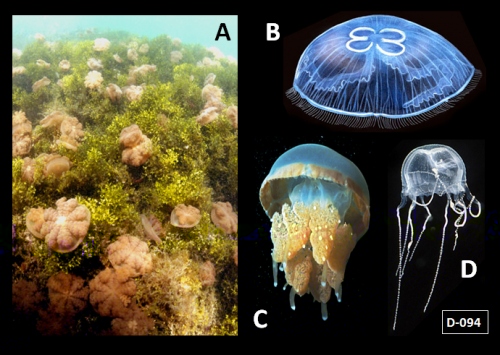
Kakaban Jelly fish
We also saw leopard sharks were relaxing fun on the white sand, which is said if we can make it convenient, it can be embraced and leopards in a photo together. After finishing the first dive, we were all close to the existing pier at Kakaban Lake, to go to Jellyfish Lake. WONDERFUL, the first word that we say after seeing an isolated brackish water lake in the middle Kakaban Island. The lake is inhabited by thousands of non-sting Jelly Fish (Jellyfish) Jellyfish jellyfish which we can touch without any shock. It is said the lake like this there are only 2 in the world other than in Palau.

Diving And Trip Maratua Island Borneo

Maratua Island

The Light House, that's the first point that we dive into the day. Shortly before arriving at the dive location, the lighthouse was visible amid towering green Maratua island cliffs. Perhaps, if lucky we could dive with Dolphin here. Dive began, along a beautiful wall and vizibility good enough at that time.

The second dive we did in 'The Channel' or say that the point of 'Big Fish Country'. After waiting for high tide, we all rushed down the entrance channel Maratua Island then energized hard enough. But precisely these currents that make the big fish fro in front of us. From Giant Trevally, Shark Grey, white tips sharks until schooling Barracuda all we can see here and click amazed invite colleagues from around here. After the flow was thrown hard enough as a safety stop, we all end very memorable diving in the day.


Sangalaki Island In Borneo

Sangalaki Island

Your Adventure Experts Island Dreams' Ken Knezick was involved in the first American familiarization trip to Sipadan, and has been representing Borneo Divers continuously since 1989. In 1992, Borneo Divers' Ron Holland invited Ken on an exploratory expedition to the then undeveloped island of Sangalaki and its sister island of Kakaban, off the coast of Indonesian Borneo.

They camped out in relatively primitive conditions, but what they saw was more than enough to convince Borneo Divers to develop a dive resort there. The partnership has since changed hands but Sangalaki Diving Lodge remains. Sangalaki is the world Capital of Mantas. At Sangalaki Diving Site the familiar set of Manta Rays emerges from all directions. Their wing tips breaking the surfaces at regular interval.

Snorkelling is the way to interact with this gentle plankton feeders. Totally unperturbed by your presence, they swim in eurythymy and sometimes glide right up to you before making a sharp nose-dive into the blue. It is not unusual to find them encircling you.

Though most of them are about 3,5 meters (12 ft) wide with a white belly, there a few black giant with a 6 meters (20 ft) wing span - we refer to them fondly as the Darth Vaders.
Located 90 miles from Tarakan, East Kalimantan, Indonesia, and lying just two degrees above the Equator, the island of Sangalaki is clothed in dense jungle forest surrounded by white sandy beaches. Shallow reefs extend out 600 meters from shore.

The soft, sandy beaches with tropical undergrowth provide the perfect natural site for turtle egg laying. As a result, Sangalaki is a prolific turtle breeding area. You will have the opportunity to see mating activity, nesting, egg laying, and baby hatchlings making their way back into the sea, completing the cylce of life. Anyone interested in wildlife will find this a truly unforgettable experience.

Sangalaki is also a breeding ground for manta rays, and sightings are a daily occurrence. It's also common to see eagle rays, sting rays, giant green turtles, leopard shark, cuttlefish, and all manor of the Indo-Pacific realm's dazzling array of tropical fish, hard and soft corals, and invertebrate life. The nearby island of Kakaban adds to the variety with a profound wall dive and its own diverse array of marine life. To complete the attraction, Kakaban's interior contains a unique jellyfish lake. Similar to the one in Palau, it is home to millions of (non-stinging) jellyfish and a host of other exotic life, including some species found no where else in the world.

Due to its unique location, a visit to Sangalaki can be accomplished in conjunction with a trip to Mabul, with exciting land touring options available throughout Borneo and Malaysia. It can just as easily be made a prime component of a trip to Bali and Indonesia. In either case, the traveler must make their way to the International Airport at Balikpapan, the major city on the Indonesian state of Kalimantan. From there, a representative will assist with the small plane flight continuing on to coastal city of Tanjung Redeb in the Berau district. In some cases, flight schedules will necessitate an overnight in Balikpapan.

The price for a week at Sangalaki is $1750 per person. This includes the boat transfer from Berau, 7 nights lodging, hotel tax, all meals, three boat dives per day, and two boat night dives per week. This price is based on four or more guests transfering at the same time, in each direction. Custom transfers, for less than four people, are at additional expense.


Airfare and any lodging on the mainland is additional. Island Dreams can assist you with your international flights, as well as the domestic air arrangements to Berau. We have years of experience, and the knowledge to help you learn more about Sangalaki, Indonesia and Malaysia. Call or E-mail to receive a free information package. Start planning YOUR ultimate dive adventure...contact Island Dreams today!

Sangalaki-Derawan Island Map

Adventure and Trip Orang Utan in Tanjung Putting National Park Kalimantan

KTanjung Puting Natioanal Park Orang Utan

Wildlife Adventure Tour "The Forest" Tanjung Putting National Park is the most popular tourism objects and is very popular in Central Kalimantan. In this tourist Tourists can see directly the jungles of Borneo's wildlife is a close look at the life of Forest People (Pongo Phymaeus), Bakantan (Nazalis Larvatus), Owa-owa (Hylobates Agili), monkey (Macaca Fascicularis) and many other forest animals such as the Warthog, Honey Bear, Crocodile, hornbills, Eagles etc.


The journey begins from Palangkaraya to the city of Pangkalan Kotawaringi Regency West, can be reached by land vehicle (car) about 11 hours traveling through the City Kasongan and Sampit or using the Aircraft (45 Minutes) further from the city of Pangkalan Bun go from here Kumai District followed by a tour boat trip (kelotok) leading to the Tanjung Putting National Park.

Furthermore, from the port of Kumai journey continues towards Tanjung Putting National Park after first completing the administrative offices Located TNTP and report themselves to Police for Foreign Tourists. If the journey starts right time (12.00 am Afternoon Hours) from Kumai then the tourists will be able to see the person directly Forest and near the Cape of Good Hope at 15.00 pm when the park officials to provide food (fedding time) journey from the port of Kumai taken towards Cape of Good Hope for 1.5 hours along the beautiful River Sekonyer.

Adventures of Wild Nature "Orang Utan"

Wildlife Adventure Tour "The Forest" Tanjung Putting National Park is the most popular tourism objects and is very popular in Central Kalimantan. In this tourist Tourists can see directly the jungles of Borneo's wildlife is a close look at the life of Forest People (Pongo Phymaeus), Bakantan (Nazalis Larvatus), Owa-owa (Hylobates Agili), monkey (Macaca Fascicularis) and many other forest animals such as the Warthog, Honey Bear, Crocodile, hornbills, Eagles etc.

The journey begins from Palangkaraya to the city of Pangkalan Bun Kotawaring Regency West, can be reached by land vehicle (car) about 11 hours traveling through the City Kasongan and Sampit or using the Aircraft (45 Minutes) further from the city of Pangkalan Bun go from here Kumai District followed by a tour boat trip (kelotok) leading to the Tanjung Putting National Park.

From the Cape of Good Hope the journey continues to see several groups Bakantan're chatting and getting to sleep in a tree-lined river ditepian Sekonyer then wisatan will rest in Rimba Orangutan Ecolodge (Hotel Wilderness). Rate room at this hotel starting from Rp. 500.000, - to Rp. 900.000, - / room / night with a choice of rooms Emerald, Sapphire, Ruby with a choice of hot water facilities, air conditioning and Fan.

On the morning after sufficient rest at Rimba Lodge Pondok Tanggui adventure continues into the wild to see the activities of forest People at Feeding Time, 09:00 pm. The journey taken for 1 Hour and 15 Minutes Tracking in the forest to where the officer TNTP provide food.

From Cottage Tanggui Sekonyer proceed down the river upstream to where Feeding Time at Camp Leakey, in this place since Sekonyer down the river you'll be greeted by various kinds of wild animals that roost in trees at the port stops kelotok at Camp Leakey you will be lucky if Forest People immediately greeted by a benign with its hospitality.

Monday, November 15, 2010

Solo Batik

Solo Batik In Central Java

Solo Batik is famous for its style and its traditional batik pattern in the stamp and in the process of batik he wrote. The materials used for staining still remains a lot of use of domestic materials such as Java soga already known since the first. The pattern remained among others, famous for "Sidomukti" and "Sidoluruh".

Laweyen is one of the central Batik in Solo. Surely this village there are a lot of history left in this vilage and became icons Batik Solo.