Showing posts with label National Park. Show all posts

Friday, December 10, 2010

Mount Leuser National Park

Mount Leuser National Park is one of the largest national parks in the world, containing over 800,000 hectares of virgin rainforest. The park is home to orangutans, gibbons, monkeys, elephants, tigers, and among the last of the Sumatran rhinoceros. There are research facilities for the study of primates, birds and insects, the Orangutans rehabilitation center at Bukit Lawang being the most popular with tourists. It is possible to raft Alas River from Ketambe to the Indian Ocean on a 4 - 5 day expedition. The journey takes us through exciting white-water rapids to the calmer, crocodile-infested waters of the lowlands. Basic accommodation is available at Ketambe. 

The Leuser National Park of Gunung Leuser is probably the wildest in Indonesia, located in Southeast Aceh, can be reached from either Kutacane, or Takengon. This magnificent national park has a wealth of flora and fauna. The Leuser Ecosystem is an outstanding wilderness in Aceh northern Sumatra. It is one of the richest expanses of tropical rain forest in Southeast Asia. More than 2.5 million hectares in size, it is the last place on earth where elephants, rhinos, tigers, clouded leopards, and orangutans are found within one area.

The first official statement of intent to protect the Leuser Ecosystem was signed in 1934. The Leuser International Foundation (a non-profit non-government organization) was established in the late 1990's when the ecosystem was seriously under threat from illegal logging and wildlife poaching.

Geographically, the Leuser Ecosystem lies between 3-4.5° North and 96.5-98° East. It covers approximately 2.6 million hectares of tropical rain forest, encompassing 890,000 hectares of designated national park, as well as extensive areas of protection and production forests. The ecosystem contains two major volcanoes, three lakes, and nine major river systems that flow to the east and west coasts of the island. 

The Leuser Ecosystem has an enormous level of biodiversity. It contains at least 127 mammal species, including the Sumatran elephant, Sumatran tiger, Sumatran rhinoceros, and Sumatran orangutan. About 8,500 different plant species grow in the beach, swamp, lowland, mountain and alpine ecosystems of the Leuser Ecosystem. Of the 10,000 plant species recorded in the West Indo-Malayan Region, 45% are found in the Leuser Ecosystem. Spectacular plants such as Rafflesia (the largest flower in the world) and Amorphophallus (the tallest flower in the world) are among the plants protected there.


Mount Leuser National Park is one of the biggest national parks in Indonesia (950,000 hectare). Actually, it's a collection of various nature reserves and forests: Nature Reserve Mount Leuser, Nature Reserve Kappi, Nature Reserve Kluet, Sikundur Langkat Wildlife Reserve, Ketambe Research Station, Singkil Barat and Dolok Sembilin. Most parts of the national park lie in the region Aceh Tenggara (SE Aceh). Other parts are situated in the region east Aceh, south Aceh, and Langkat.

Mount Leuser National Park comprises more than 100 kilometers of the Bukit Barisan Mountains. Because of that, the park consists of steep, almost inaccessible mountainous terrain. The altitude ranges from 0 meter, in Kluet (South Aceh), to 3,381 meter, on top of the mount Leuser (Southeast Aceh). The Alas River cuts the park into an eastern and western half. Apart from mountains we find several other ecosystems: beach forest, swamp areas, lowland rainforest, alpine and mountain forest. In Bukit Lawang is the Orang Utan Rehabilitation Station and in Ketambe stands the Ketambe research station.[source : Gunung Leuser]

See The Beauty


Wednesday, November 10, 2010

Alas Purwo National Park

Alas Purwo National Park is situated on Blambangan Peninsula in Banyuwangi regency, at the southeastern tip of East Java province. Alas means forest or jungle and Purwo means the beginning of everything. 

Alas Purwo National Park is representative of a typical lowland tropical rain forest ecosystem in Java. Peculiar and endemic species of plant that grow in this Park include sawo kecik (Manilkara kauki) and manggong bamboo (Gigantochloa manggong). Among the other plants that can be found here are ketapang (Terminalia cattapa), nyamplung (Calophyllum inophyllum), kepuh (Sterculia foetida), and keben (Barringtonia asiatica). Moreover, there are 13 different species of bamboo. 

Alas Purwo National Park is a habitat for several species of wildlife such as the ebony leaf monkey (Trachypithecus auratus auratus), banteng (Bos javanicus javanicus), Asian wild dog (Cuon alpinus javanicus), green peafowl (Pavo muticus), red junglefowl (Gallus gallus), deer (Cervus timorensis russa), panther (Panthera pardus), and leopard cat (Prionailurus bengalensis javanensis). Some species of turtle like the Pacific ridley (Lepidochelys olivacea), leatherback (Dermochelys coriacea), hawksbill (Eretmochelys imbricata), and common green (Chelonia mydas) are often seen landing on the southern beach of this Park between January and November.

In the period from October to December, some 16 species of migrant bird from Australia such as the sacred kingfisher (Halcyon chloris/Todirhampus sanctus), blue-tailed bee-eater (Merops philippinus), common sandpiper (Actitis hypoleucos), and wood sandpiper (Tringa glareola) can be seen in Bedul Segoro Anak.

Plengkung, in the southern part of the Park, is almost legendary among the world's top surfers. They call it "G-Land". The name is derived from its location in Teluk Grajagan (Grajagan Bay), which resembles the letter "G". Moreover, it is located a short distance from a stretch of tropical rain forest which always looks green (hence green land or "G-land"). Plengkung is one of the top four locations for surfing in the world and can be ranked alongside surf sites in Hawaii, Australia, and South Africa.

Walking along the white sand beach from Trianggulasi to Plengkung, visitors will come across an area of buckshot-like sand. The grains are yellow in colour and have a diameter of around 2.5 mm.

The communities living around the Park are very typical of the "Blambangan" culture. They believe that what is now the Park was the last stopover of the Majapahit people who were escaping the onslaught of the Mataram kingdom, and they are convinced that hidden somewhere in the park is a sacred kris, or dagger, named "Keris Pusaka Sumelang Gandring". For this reason, it is not unusual for people to meditate or hold religious ceremonies in the Park, particularly in Goa Padepokan and Goa Istana.
 
Near the Rowobendo entrance gate there are historical remains in the form of "Pura Agung", a Hindu temple, where a Hindu ceremony, "Pagerwesi", is held every 210 days.

This Park has a diversity of ecotourism and cultural tourism attractions (sea, sand, sun, forest, wild animals and traditional cultures) which are located in close proximity to one another. [source : Alas Purwo]

See The Beauty
 

Friday, August 20, 2010

Wakatobi Marine National Park


Wakatobi National Park is a marine national park, south-east of Sulawesi island of Indonesia. The name of Wakatobi is an acronym of the four main Tukangbesi Islands: Wangi-wangi, Kaledupa, Tomia, and Binongko. Since 2005 the park is listed as a tentative World Heritage Site.

It consists of four larger islands: Wangi-Wangi, Kaledupa, Tomia and Binongko, as well as many small islands such as Tokobao, North Lintea, South Lintea, Kampenaune, Hoga and Tolandono. The highest elevation is 274 metres (899 ft) on Wangi-Wangi, followed by Lagole Hill (271m) on Tomia, Terpadu Hill (222 m) on Binongko and Mount Sampuagiwolo (203 m) on Kadelupa. The water depth varies, with the deepest parts reaching 1,044 metres (3,425 ft).

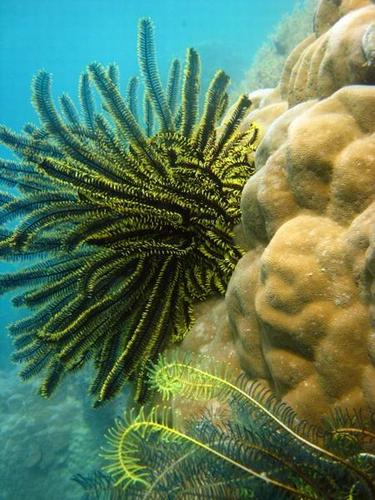
The types of vegetation found in the national park are mangrove forest, coastal forest, lowland swamp forest, riverbank vegetation, lowland rainforest, mountain rainforest and coral reefs. The Wakatobi Archipelago has 25 groups of coral reefs including fringing reefs, barrier reefs and atolls. A survey conducted in 2003 identified 396 species of coral belonging to 68 genera and 15 families. These include Acropora formosa, Acropora hyacinthus, Psammocora profundasafla, Pavona cactus, Leptoseris yabei, Fungia molucensis, Lobophyllia robusta, Merulina ampliata, Platygyra versifora, Euphyllia glabrescens, Tubastraea frondes, Stylophora pistillata, Sarcophyton throchelliophorum, and Sinularia species.

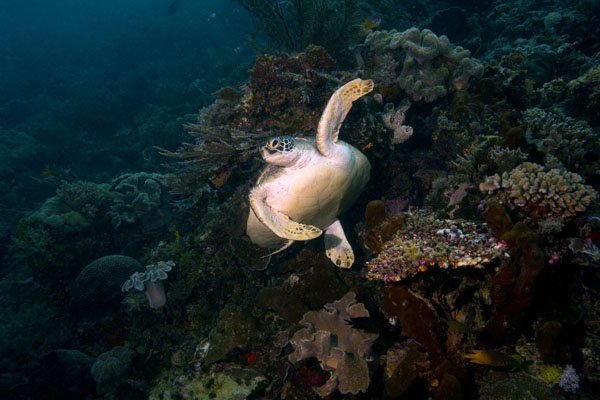
Among the recorded species of seabird are the Brown Booby, Common Kingfisher and Malaysian Plover. Turtles in the park include the Hawksbill turtle, Loggerhead sea turtle, and Olive Ridley. 

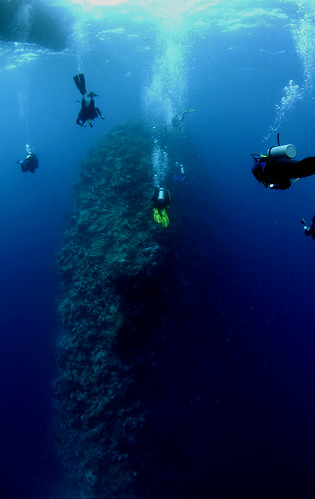
The park is one of the best diving destinations in the world with excellent opportunities for drift diving, coral reef exploration and marine life encounters. [source : Wakatobi]

See The Beauty


Monday, July 5, 2010

Seribu Islands

Seribu Islands (English : Thousand Islands) lies in the waters of Jakarta Bay which has 100 miles length and 108,000 ha width. There’re about 110 islands, in some large and small group of islands in the Seribu Islands. Those islands divided into tourism islands, conservation, historical island, and island for community empowerment in accordance with the characteristics differences between each island.

Seribu Islands is a district under the government of DKI Jakarta Province and is headed by a regent which office is on Pramuka Island. As the capital district, Pramuka Island has a complete infrastructure such as school buildings, sports facilities, an integrated security system to health facility and hospital units with some speed boat ambulance.

Here are diving, snorkeling and fishing opportunities, or just good for lazing in the sun with nothing to disturb one’s mind except the chirping of birds amidst the gentle lapping of the waves.
The idyllic Thousand Islands are in fact a marine nature conservation area. Here are a wealth of sea biota species which form part of its coral reef ecosystem, there are 144 species of fish, 2 species of giant clam, sea worms of various colours and 17 species of coastal birds.

The Kepulauan Seribu National Park is a hatching site for hawksbill turtles and green turtles. The hawksbill turtle is an endangered species, rarely found in other waters. They are primarily bred on the island of Pramuka. Most of the islands are ringed by coconut palms and mangrove forests, where iguanas, golden ring snakes and pythons can be found.

There are 45 islands that are meant for tourism destination which are classified into general tourism and special tourism. Among the islands that are included in Seribu Islands, six of them have been made as the tourism islands. Those six islands are Ayer Island, Bidadari Island, Kotok Island, Putri Island, Pantara Island, and Sepa Island. Those tourism islands equipped with adequate and even complete facilities and infrastructure. [source : Seribu]

See The Beauty


Saturday, June 26, 2010

Ujung Kulon National Park

Ujung Kulon National Park is located at the western-most tip of Java, Banten, Indonesia. It includes the volcanic island group of Krakatoa and other islands including Panaitan, Handeuleum and Peucang. The park encompasses an area of 1,206 km² (443 km² marine), most of which lies on a peninsula reaching into the Indian Ocean. The explosion of nearby Krakatau in 1883 produced a tsunami (giant wave) that eliminated the villages and crops of the coastal areas on the western peninsula, and covered the entire area in a layer of ash about 30 cm thick. This caused the total evacuation of the peninsula by humans, thereby allowing it to become a repository for much of Java’s flora and fauna, and most of the remaining lowland forest on the island.

Javan Rhinoceros
It is Indonesia's first proposed national park and was declared a UNESCO World Heritage Site in 1991 for containing the largest remaining lowland rainforest in Java. It is also one of only two homes of the critically endangered Javan Rhinoceros. A population of fifty to sixty live in Ujung Kulon, a smaller population of possibly 10 or less, live in Cat Tien National Park, Vietnam. The park protects 57 rare species of plant. The 35 species of mammal include Banteng, Silvery Gibbon, Javan Lutung, Crab-eating Macaque, Leopard, Java Mouse-deer and Rusa Deer. There are also 72 species of reptiles and amphibians, and 240 species of birds.
Parts of today's national park and World Heritage site have been protected since the early 20th century. Karakatoa Island was declared a Nature Reserve in 1921, followed by Pulau Panaitan and Pulau Peucang Nature Reserve in 1937. The Ujung Kulon Nature Reserve has been established in 1958 followed by the Gunung Honje Nature Reserve in 1967. Ujung Kulon National Park has been established in 1992. In 2005 the park has been designated as an ASEAN Heritage Park. [source : Ujung Kulon]

See The Beauty


Thursday, June 17, 2010

White Sand Beaches of Karimunjawa Islands

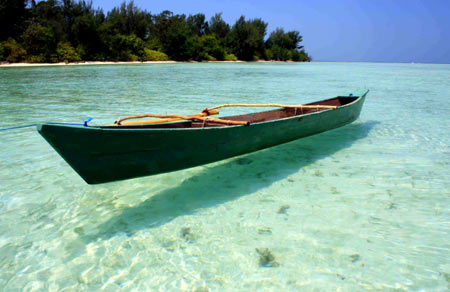
Karimunjawa is an island chain stretching in a northwesterly direction 83 km from Jepara. Central Java. This archipelago is a cluster of 27 islands in the java sea. Only seven of the islands are inhabited. The reefs are a mixture of fringing, barrier, and patch with bottom depths ranging from 15 to 40 meters. 

The name of Karimunjawa is taken from Javanese language 'Kremun kremun saking tanah Jawi' addressed by one of Wali Songo (the Nine Saints who had introduced Islam in Java) to describe how far this mini archipelago from Java, to be exact from Semarang and Jepara. Stands from 27 islands, this mini archipelago became marine national park and it's like a treasure for those who love marine life. Here can be found protected coral reefs (very colorful plateaus and plains in deep and shallow waters), secluded and tranquil white beaches, pelican and hornbill, sea grass and kinds of sea creatures, from crabs, anchovy, starfish, sharks, stingray, jellyfish, red snappers, etc.

The Marine National Park Karimun Jawa is 110,000 ha and lies 90 km north east of Jepara in Central Java. We will find mangrove forest and beach forest. The park is named after the largest island Karimun Jawa. The vegetation consists mainly of mangrove and beach forest, although there is some lowland rain forest on Karimun Jawa. Most of the islands are surrounded by sandy beaches and fringing coral reefs. Fresh water is confined to a few small wells and forest streams on Karimun Jawa. A number of endemic animals live on the island while on the beaches sea turtles lay their eggs. The average tidal range is 92 cm.

The archipelagic Karimunjawa, thought not as known the Marine reserves near Ambon and Manado, has unexpectedly good beaches, reefs and lovely sea scopes. Corals seem to blossom in to gardens, with an Amazing variety of form and color fishers and marine plants. It lies 90 km away from Jepara and can reached by "KM. Adison I & KM Kota Ukir" boat, the only ferryboat connecting Karimunjawa and Jepara. The resort offers stunning dives and snorkeling trips for all sorts of divers from novice to experience. Fringing reefs, atolls, wrecks and an excellent variety of different species make diving in Karimunjawa an unforgettable adventure. [source : Karimunjawa]

See The Beauty


Sunday, May 30, 2010

Bunaken National Marine Park : A Paradise Under The Sea

The Bunaken National Marine Park was formally established in 1991 and is among the first of Indonesia's growing system of marine parks. The park covers a total surface area of 89,065 hectares, 97% of which is overlain by sparkling clear, warm tropical water. The remaining 3% of the park is terrestrial, including the five islands of Bunaken, Manado Tua, Mantehage, Nain and Siladen. Although each of these islands has a special character, it is the aquatic ecosystem that attracts most naturalists.

The waters of Bunaken National Marine Park are extremely deep (1566 m in Manado Bay), clear (up to 35-40 m visibility), refreshing in temperature (27-29 C) and harbor some of the highest levels of biodiversity in the world. Pick any of group of interest - corals, fish, echinoderms or sponges - and the number of families, genera or species is bound to be astonishingly high. For example, 7 of the 8 species of giant clams that occur in the world, occur in Bunaken. The park has around 70 genera of corals; compare this to a mere 10 in Hawaii. Although the exact number of fish species is unknown, it may be slightly higher than in the Philippines, where 2,500 species, or nearly 70% of all fish species known to the Indo-western Pacific, are found.

Oceanic currents may explain, in part, why Bunaken National Marine Park is such a treasure trove of biodiversity. Northeasternly currents generally sweep through the park but abundant counter currents and gyros related to lunar cycles are believed to be a trap for free swimming larvae. This is particularly true on the south side of the crescent-shaped Bunaken Island, lying in the heart of the park. A snorkler or diver in the vicinity of Lekuan or Fukui may spot over 33 species of butterfly fish and numerous types of groupers, damsels, wrasses and gobies. The gobies, smallish fish with bulging eyes and modified fins that allow them to attach to hard surfaces, are the most diverse but least known group of fish in the park.

Biologists believe that the abundance of hard corals is crucial in maintaining the high levels of diversity in the park. Hard corals are the architects of the reefs, without them, numerous marine organisms would be homeless and hungry. Many species of fish are closely associated with particular types of corals (folious, branching, massives, etc.) for shelter and egg-laying. Others, like the enormous Bumphead Parrotfish, Balbometopon muricatum, are "coralivores" and depend on hard corals for their sustenance. Bony mouth parts fused into an impressive "beak" allow these gregarious fish to crunch corals like roasted peanuts.

Some 20,000 people live on the natural resources of Bunaken National Marine Park. Although there are inevitable conflicts between resource protection and use by people, the Indonesian government is taking a fairly unusual and pragmatic approach to park management. The idea is to promote wise resource use while preventing overexploitation. Local communities, government officials, dive resort operators, local nature groups, tourists and scientists have played an active role in developing exclusive zones for diving, wood collection, fishing and other forms of utilization. Bunaken Marine Park has become an important example of how Sulawesi, and the rest of Indonesia, can work to protect its natural resources.


See The Beauty